
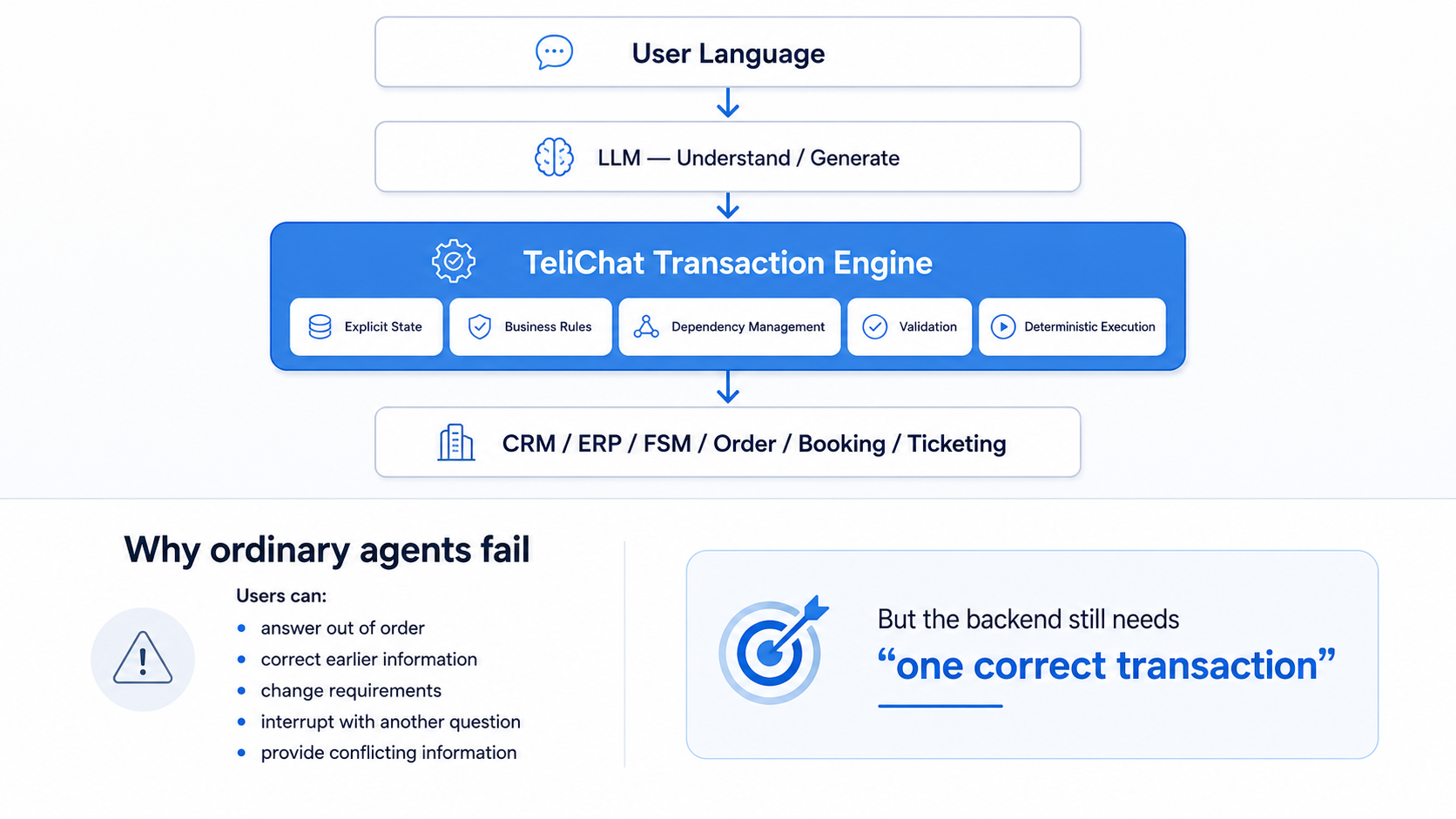

Core Architecture
Dialogue Modeling via "ChatTree" and "InfoItem"
Interaction Logic over Process Execution
- Models dialogue interaction via ChatTree, transcending the sequential execution limits of traditional workflows.
- Transitions are dynamic — driven by the composite state of information and user intent — rather than just static topology.
Composite State over Single Node State
- Replaces workflows single-node tracking with a "complex composite state" derived from all InfoItems for superior expressiveness.
- Combines tree topology, real-time state constraints, and Python to maximize hallucination suppression for complex logic.
Synergy of Three Core Capabilities
- ChatTree: Precisely models interaction and dialogue state flow via DAG
- LLM: Focuses on natural language understanding (intent recognition, information extraction) and generation
- Python: Executes complex business logic and tool calling, avoiding hallucinations and inefficiencies when LLMs undertake these responsibilities
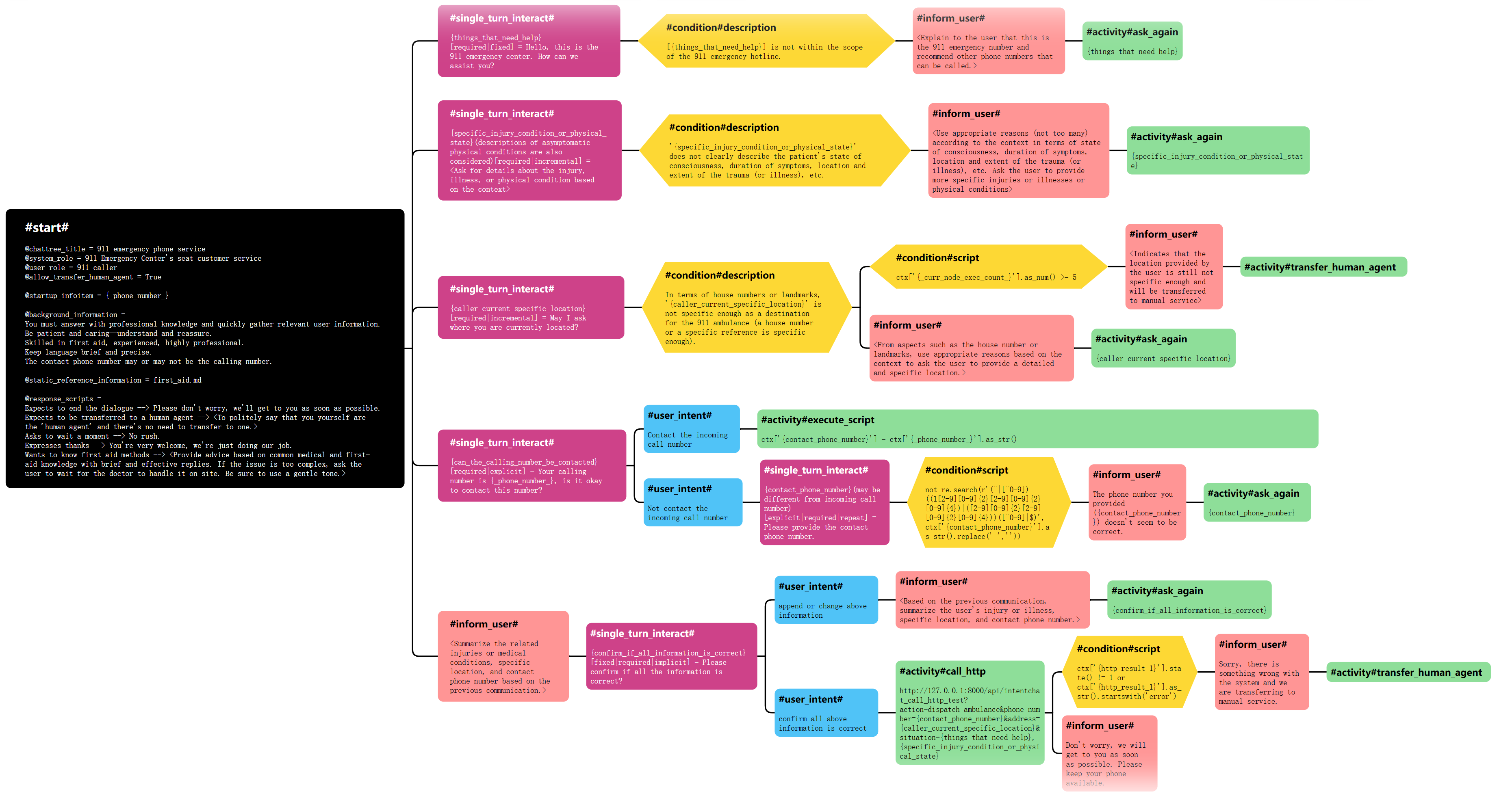
Example: ChatTree (built by using Xmind)
Intelligent Interaction
Mastering Unordered Inputs, Topic Switching and Precise Semantic Control
Global Information Extraction
- Seamlessly handles out-of-sequence inputs, corrections, supplements, and refusals, overcoming traditional slot-filling limits.
Global Intent and Topic Management
- Automatically supports topic skipping, insertion, resumption, switching and re-entry.
- Automatically injects RAG context and response scripts at any interaction node, ensuring uninterrupted flows.
Precise Semantic Control
- Defines semantic explicitness (Implicit or Explicit) per turn.
- Flexible strategies: Re-asking, mandatory answers, and fixed-node information extraction.
- Auto confirm user answers, can dynamically generate questions and can also poll different question methods.
Development Paradigm
Code-Centric, Visual Graph, and Declarative
Dual-Mode ChatTree Construction
- Build ChatTree via Python with auto-generated interactive HTML visualizations.
- Or build via Xmind which can be executed directly.
- Both methods are functionally equivalent.
Seamless Code Integration
- Execute Python logic in specific nodes, or during conditions, state updates, and dynamic retrievals.
- Unified "ctx" object for data sharing across Python, LLMs, and ChatTree.
Declarative Prompting
- Replace complex prompt engineering with natural language descriptions of user intent, required information, output to user, and validation.
- Best practices is ready.
Example: Defining ChatTree in Python
911.py
Loading code...
Example: Interactive ChatTree HTML auto-generated from above Python code (features: search, zoom, pan, tooltips)
Engineering
White-box, Large Scale Complexity and High Performance
End-to-End Observability and IDE Breakpoint Debugging
- Full execution traces: decision rationale, state transitions, and token usage.
- Inspect InfoItem states and Python variables via VS Code breakpoints.
- Each ChatTree node supports breakpoints before and after execution.
Large Scale Complexity
- A single ChatTree supports hundreds or thousands of nodes.
- A single ChatTree supports hundreds or thousands of rules such as response scripts, dynamic reference information, intent trigger.
- A single ChatTree supports hundreds or thousands of InfoItems, and a single InfoItem can have hundreds of (semantic) candidate values that can be strictly limited in scope.
Ultra-Fast Response
- Abandon "ReAct loops", "LLM Function Call" and "LLM thinking modes" that are not suitable for customer service dialogue response speed requirements
- Uses non-JSON LLM outputs to boost speed and reduce token consumption.